
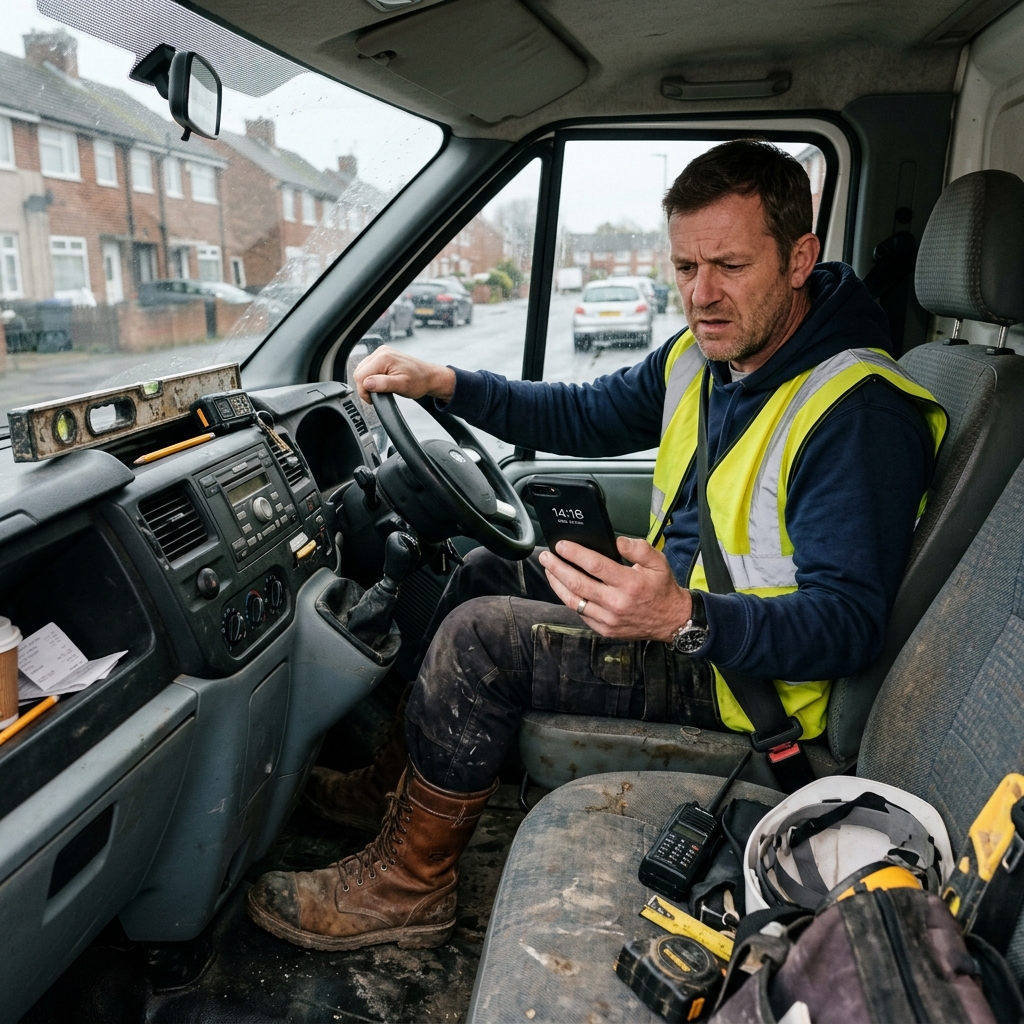
Here's a question that keeps tradesmen awake at night: how many jobs did you lose this week without even knowing about it?
Not jobs you quoted and lost. Not jobs that went to a cheaper competitor. Jobs where someone picked up their phone, searched "plumber near me" or "electrician in [your town]", found your number, called you — and you didn't answer.
They hung up. Called the next result. Booked someone else. You never even knew they existed.
The Maths Nobody Talks About
Let's be honest about the numbers. If you're a busy tradesman — out on jobs from 8am to 5pm most days — you're physically unable to answer your phone for the majority of the working day. You're under a boiler. You're on a roof. You're elbow-deep in a consumer unit. You're driving between jobs.
The average sole trader receives fifteen to twenty-five calls per week. Of those, roughly half are new enquiries. If you're missing even a third of your calls — which is conservative — that's three to five genuine jobs walking out the door every single week.
At an average job value of £300, that's £900 to £1,500 per week. £3,600 to £6,000 per month. £45,000 to £72,000 per year.
Read that again. You could be losing the equivalent of a second income just because you can't pick up the phone while you're working.
Why Voicemail Doesn't Work
The standard response is "they'll leave a voicemail." No, they won't. Fewer than 20% of callers leave a voicemail. The other 80% hang up and call the next tradesman on the list.
Think about your own behaviour. When was the last time you left a voicemail for a business? You probably can't remember. Customers behave exactly the same way. They want to speak to someone, not talk to a machine.
This is especially true for emergency work — burst pipes, electrical faults, lockouts. These customers need someone now. They're not leaving a voicemail and hoping you call back in two hours. They're calling the next plumber, the next electrician, the next locksmith within thirty seconds of hearing your voicemail greeting.
The "I'll Call Them Back" Myth
Even when you do spot a missed call and ring back, the damage is usually done. Studies show that the first tradesman to answer wins the job 78% of the time. By the time you've finished the current job, driven to the next one, and remembered to return those three missed calls, the customer has already had a conversation with someone else, feels comfortable with them, and has booked them in.
You're not competing on price at that point. You're not competing on quality. You're competing on who picked up the phone first. And you lost before you even knew there was a race.
The Feast-Or-Famine Cycle
This is what creates the feast-or-famine pattern that plagues most trade businesses. Some weeks you're turning work away. Some weeks you're wondering whether to take a job two hours away because nothing local has come in.
The irony is that during your busiest weeks — when you're turning work away — you're also missing the most calls. Those missed calls are the jobs that would have filled your quiet weeks. But because you couldn't answer, they went to someone else, and two weeks later you're scrambling for work.
Consistent call answering creates consistent work. It's that simple.
The Fix: Never Miss Another Call
The solution isn't complicated. You need someone — or something — answering your phone every time it rings, whether you're on a job, driving, or asleep.
The traditional options are expensive:
- Hiring a receptionist: £24,000+ per year, only covers office hours, calls in sick, takes holidays
- Virtual receptionist service: £300-500 per month, but they handle multiple businesses simultaneously — your customer might get put on hold
- Asking your partner to answer: Works until it doesn't (and it damages relationships)
The modern solution is an AI receptionist built specifically for tradesmen. Your AI receptionist answers every call in your business name, has a genuine conversation with the customer, captures all the details you need (name, number, what they need, where they are, how urgent it is), and sends you a complete summary before the customer has even hung up.
The customer feels like they've spoken to a professional business. You get a qualified lead summary. Nobody hangs up and calls your competitor.
What Does This Actually Look Like?
Picture this. You're halfway through a boiler installation. Your phone rings. Instead of it going to voicemail, your AI receptionist answers:
"Good morning, you've reached [Your Business Name]. How can I help you today?"
The customer explains they need an emergency plumber — their kitchen tap is leaking badly. Your AI receptionist captures their name, address, and phone number, assesses the urgency, and reassures them that you'll be in touch as soon as possible. your AI receptionist sends you a notification immediately.
You finish the boiler install, check your phone, and see a complete lead summary. You call the customer back within the hour. They're relieved, they book you in, and you've won a job that would have gone to someone else.
Beyond Phone Answering: The Complete System
Phone answering is the most urgent fix because it has the most immediate impact. But it's just one part of a complete AI lead generation system for tradesmen.
The full system includes:
- AI Receptionist: Answers every call, captures every lead — from day one
- Lead Generation Website: A website that actually ranks on Google for the searches your customers make — generating the calls in the first place
- AI Marketing: Turns every completed job into content that attracts the next customer — blog posts, social media, Google Business updates
Together, these three elements create a lead generation flywheel where each component strengthens the others. Your website generates calls. Your AI receptionist captures them. Your marketing compounds your online presence. The flywheel spins faster with every job you complete.
The Bottom Line
You didn't become a tradesman to sit by the phone waiting for it to ring. You became a tradesman because you're brilliant at what you do — plumbing, electrical work, roofing, building, whatever your craft is.
But the best tradesman in the country still loses if they can't answer the phone. And right now, you're losing three to five jobs every single week because you're too busy doing the work to answer the calls that bring in more work.
That's not a business problem. That's a solvable problem.
An AI receptionist costs £45 per month. One job pays for a year of the service. Every missed call you capture after that is pure profit.
The question isn't whether you can afford it. The question is how many more jobs you're willing to lose before you fix it.